Tuesday, December 18, 2012

Tenn. considering training and arming teachers

Tennessee has emerged this week as a center of the "the answer is more guns in schools" sentiment following the Newtown, Conn. elementary school shooting.

A member of the Republican-controlled legislature plans during its upcoming session to introduce a bill that would allow the state to pay for secretly armed teachers in classrooms so, the sponsor told TPM, potential shooters don't know who has a gun and who doesn't.

Tennessee Gov. Bill Haslam (R) has said the idea will be part of his discussions about how to prevent a shooting like the one in Newtown from happening in the Volunteer State.

As has been seen following other mass shootings, there's a strong segment of the gun rights lobby that says the answer to events like the one in Newtown is more guns in more places. But they've said the recent massacre shows how important it is to put guns into elementary schools, where even gun-friendly states like Tennessee don't currently allow them.

State Sen. Frank Niceley (R) told TPM on Tuesday he believes it's time for that to change. He plans to introduce legislation in the next session, which begins Jan. 8, that will require all schools to have an armed staff member of some kind. The current language of the bill -- which is in its early form -- would allow for either a so-called "resource officer" (essentially an armed police officer, the kind which most Tennessee high schools have already) or an armed member of the faculty or staff in every school in the state. The choice would allow schools that can't afford a resource officer to fulfill the requirement without having to pay for anything beyond the cost of the training and, presumably, the weapon. But Niceley said schools should use the wiggle room to train and keep on hand armed staff not in uniform.

That's the best way to protect students, he said.

"Say some madman comes in. The first person he would probably try to take out was the resource officer. But if he doesn't know which teacher has training, then he wouldn't know which one had [a gun]," Niceley said by phone. "These guys are obviously cowards anyway and if someone starts shooting back, they're going to take cover, maybe go ahead and commit suicide like most of them have."

Niceley described himself as a person who as grown up around guns his whole life and a strong supporter of gun owners' rights. He tussled with the NRA during his last election over the letter grade he received from the group, though for the most part he's been rated A+.

Niceley's proposal has gathered some high-level interest. Tennessee's governor told reporters Monday that he's open to including it on the agenda for a January conference to discuss school safety. Nicely said he expect the governor "to be receptive" to his plan to use tax money to arm and train teachers.

Asked about concerns from gun control advocates that putting more guns in schools in the wake of Newtown might make them more dangerous, Niceley said the sentiment was naive. Not only does an unarmed school leave itself unprotected, he said, it also presents a tempting target.

"Look at it this way, you never see one of these whacko shooters go to a gun show and start shooting. They don't go down to the police station and start shooting," he said. "They go to places we advertise are gun-free."

School resource officers are paid jointly by the local sheriff's department and the school district. Niceley's bill would allow schools to pay for background checks and firearms training for teachers that woud allow them to be armed as well. Asked if the guns for the trained teachers would also be part of the taxpayer expense, Niceley laughed.

"Well, that's a minor detail in Tennessee," he said. "We hoped the teachers would have them already."

The teachers that would be trained would be volunteers, he said, and would likely carry their own firearms to school.

Source: http://news.yahoo.com/tennessee-considers-training-arming-schoolteachers-protect-against-shootings-192556978--politics.html

undrafted free agents braveheart earthquake california earthquake california roy orbison the third man 2012 nfl draft order

Saturday, December 15, 2012

Oregon lawmakers OK tax deal for Nike expansion

Signs protesting emergency legislation requested by apparel giant Nike Inc., greet visitors arriving at the Oregon state Capitol in Salem, Ore., on Friday, Dec. 14, 2012. The Legislature is considering a tax deal requested by Nike in exchange for bringing hundreds of new jobs to Oregon. (AP Photo/Jonathan J. Cooper)

Signs protesting emergency legislation requested by apparel giant Nike Inc., greet visitors arriving at the Oregon state Capitol in Salem, Ore., on Friday, Dec. 14, 2012. The Legislature is considering a tax deal requested by Nike in exchange for bringing hundreds of new jobs to Oregon. (AP Photo/Jonathan J. Cooper)

FILE - In this Sept. 29, 2006 file photo, the red Nike swoosh marks the entrance to the company's headquarters campus in Beaverton, Ore. Nike wants to expand its Oregon operations and hire as many as 12,000 new workers by 2020 but wants the government to promise it won't change the state tax code. Oregon Gov. John Kitzhaber says he'll call the Legislature into session Friday to create a law to give Nike its promise. (AP Photo/Don Ryan, File)

The Oregon House meets in Salem, Ore., on Friday, Dec. 14, 2012 to consider a tax deal requested by apparel giant Nike Inc., in exchange for bringing hundreds of new jobs. The governor called a special session that will cost taxpayers $13,000 a day, and is evidence of the lengths Oregon will go to protect its best-known company. (AP Photo/Jonathan J. Cooper)

Oregon House Co-Speaker Bruce Hanna, R-Roseburg, opens a special session Friday, Dec. 14, 2012, in Salem, Ore. The Legislature is considering a tax deal requested by apparel giant Nike Inc., in exchange for bringing hundreds of new jobs. (AP Photo/Jonathan J. Cooper)

This Aug. 11, 2012 file photo shows the Nike campus from the air. Athletic footwear and apparel giant Nike Inc. plans to expand its operations in Oregon and hire hundreds of workers but wants the government to promise that tax rules won't change, prompting a special session of the Legislature. Gov. John Kitzhaber said he'll call lawmakers together Friday Dec. 14, 2012 in Salem to create a new law authorizing him to grant Nike's wish, and legislative leaders said they'll go along. (AP Photo/The Oregonian, Torsten Kjellstrand)

(AP) ? A deal proposed by Nike Inc. to create hundreds of jobs in Oregon in exchange for a guarantee that the state won't change a favorable corporate tax structure has prompted state lawmakers to approve emergency legislation.

Critics have questioned the timing and purpose of the special session. But rather than head out on holiday vacations, the state's part-time legislators met Friday in Salem on four days' notice and voted to give the world's largest athletic shoe and apparel company the assurances it demanded.

The deal was evidence of the lengths Oregon leaders will go to in order to protect the state's best-known company, and the economic footprint, with its trademark swoosh, that Nike has in the state.

"We have a wonderful, wonderful company that's going to be remaining in Oregon because of what we're doing here today," said Democratic Sen. Ginny Burdick of Portland.

Gov. John Kitzhaber's decision to call the special session stunned lawmakers who didn't see it coming, underscoring that even as tax incentives have become a common tool for politicians to lure large employers, Nike's deal is unconventional.

The meeting cost taxpayers $13,000 and came less than two months before the regular legislative session was set to convene. It is aimed at maintaining the status quo, rather than approving new tax breaks.

Such factors led Kitzhaber to acknowledge the emergency legislative session was "extraordinarily awkward."

Still, Nike plans to create 500 or more jobs and invest at least $150 million in an expansion if the so-called "single sales factor" tax benefit remains in place, according to the Democratic governor. The governor will sign the bill, potentially as soon as next week, spokesman Tim Raphael said.

It was unclear whether Nike would actually move to expand outside of Oregon ? a company spokeswoman refused to say ? but the mere threat was enough to prompt action.

In a statement, Nike spokeswoman Mary Remuzzi thanked legislators for acting "quickly and decisively."

"This is a very positive step forward, not only for our company but for the state of Oregon," the statement said.

The prospect of many new workers is critical in a state that has no sales tax, limited property taxes and relies heavily on personal income taxes, said Republican Rep. Vicki Berger of Salem.

Nike employs thousands of people in Oregon, many of them at its headquarters in relatively high-wage jobs, including legal, design, sales, information technology and corporate strategy.

Company officials have been mum about their expansion plans, refusing to say where they'll build or what the new workers will do.

The company's presence near Beaverton, a Portland suburb, has helped make the area a hub for athletic and outdoor apparel companies. Columbia Sportswear's global headquarters is in Beaverton, and Adidas has its North American headquarters in Portland.

Nike has deep roots in Oregon, where it was created in the 1960s by a former middle-distance runner and his college track coach. Together, Phil Knight and Bill Bowerman built the company into one of the globe's most influential brands.

Knight also is the largest contributor to University of Oregon athletics, and his money is considered a key factor in vaulting the school's football program into national prominence.

Kitzhaber has said Nike approached his staff about a month ago, saying the company was being courted by other states but would expand in Oregon if officials promised to keep in place the substantial tax benefits for companies that employ many people in Oregon but sell most of their goods elsewhere.

The legislation passed Friday would authorize the governor to give Nike that promise for up to 30 years.

A handful of people opposed to the legislation set up anti-Nike signs in front of the Capitol as lawmakers met inside.

"You cannot do this in such a rushed manner, and this is just not an emergency," Susan Barrett of Portland told lawmakers.

Associated Press

Source: http://hosted2.ap.org/APDEFAULT/f70471f764144b2fab526d39972d37b3/Article_2012-12-15-Special%20Session-Nike/id-6e56da98d549484ca5fc46154b4725d4

f 18 jet crash in virginia beach john tortorella nicki minaj beez in the trap video food network good friday f/a 18

The Stoner Channel: Loud Paint, Clean Rips, and The World's Biggest Ice Cube

More »


Source: http://feeds.gawker.com/~r/gizmodo/full/~3/_sUMAUfjhhE/

st. joseph puerto rico primary manning peyton florida state meghan mccain wilson chandler

Meredith Bagby: Harvard Study Reports: In Fiscal Cliff Talks, States May Lose

You haven't heard a lot about it so far in the fiscal cliff debate, but a new report out from Harvard University and the University of Pennsylvania indicates that the majority of the "pain" to come from budget cuts will trickle down to states and cities. As a result, our local governments will undoubtedly have to cut back on basic services to citizens. K-12 education, nutrition for kids, policing, funding of public universities and the maintenance of our roads, bridges and parks could take the biggest hits.

The States Project, produced by Harvard University's Institute of Politics and the University of Pennsylvania's Fels Institute, as well as the American Education Foundation (of which I am the current Executive Director), explains it this way:

If past is prologue, lawmakers will likely try to avoid big cuts to the most politically protected programs -- Social Security, Medicare and defense -- which together make up over half of the federal budget. Once all mandatory spending is considered (including Social Security, Medicare, interest on the debt, and block grants to Medicaid), a relatively small portion of the national budget -- less than 30% -- is left to debate. Contained in that 30% are many of the discretionary block grants to states, which help support programs that are crucial to the everyday lives of Americans: K-12 education, funding for colleges and universities, unemployment compensation, public housing, school lunch programs, state parks, and infrastructure. While grants make up only 16% of federal outlays as a whole, they make up more than 40% of this discretionary portion of the budget" -- or the part of the budget most likely headed for the chopping block.

The report notes that state block grants are on the chopping block because states don't really have advocates in Washington to lobby for state interests. There is no formal avenue by which state representatives can participate in the federal budget process -- a serious fault in our political system, and one that has real consequences for states and their citizens in the coming era of fiscal austerity.

Concerned governors formed an emergency bipartisan coalition to lobby the federal government on these issues. The group met with Vice President Biden last week to make their concerns heard. Even so, state concerns will likely get drowned out by the louder partisan noise between the national parties.

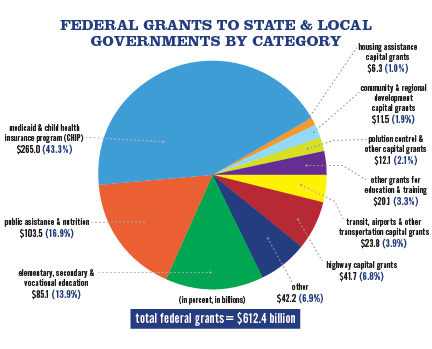
According to the Harvard/Penn report, Medicaid is the largest category of state block grants, accounting for almost 43 percent of all federal grants, or $265 billion in fiscal year 2011. Other social safety net programs (unemployment benefits, food stamps, etc.) constitute about 17 percent of the federal grants to states; education and training make up another 17 percent; and infrastructure and capital needs are roughly 16 percent.

2012-12-14-FG7ESfederalgrantstostatespie.jpg


The president's budget for fiscal year 2013 projects increases in grants to states for "mandatory" programs -- driven primarily by rapid growth in Medicaid, which will be expanded by the Affordable Care Act (aka Obamacare). But the same budget projects a decline in outlays for almost everything else. According to the Congressional Budget Office, spending for education, transportation, housing and welfare programs for children will likely shrink by 35 percent between 2012 and 2022. Conversely, the CBO expects federal spending for Medicaid and CHIP to increase by 47 percent in those years.

The report says that these projections indicate that Medicaid is "crowding out" other areas of state spending. Assuming that the federal government has dwindling funds for state block grants, Medicaid will take a greater share of the total, leaving less available for other state spending needs.

The consequences of the reductions in federal block grants to states will trickle down to cities and localities, which are, in many ways, the most vulnerable part of our governmental structure. In order to balance budgets, state governments will likely have to cut spending to local governments. State aid to local governments represents the largest source of revenues for municipalities, comprising approximately 34 percent of municipal budgets.

The States Project indicates that many local governments may face major budget shortfalls if state aid is significantly reduced, having already depleted "rainy day" funds during the Great Recession. In addition, raising municipal debt may be more difficult if cities are perceived to be a bad credit risk. The recent Chapter 9 defaults of some larger cities like Stockton or San Bernardino, both in California, as well as a plethora of credit downgrades for other cities, may give investors pause. From 2009 to 2011, for example, municipal downgrades by Moody's have outnumbered upgrades by three to one.

"Since cities are the last stop on the government money train, budget gaps for localities will have to be addressed primarily with a combination of reductions in public services, some privatization, and tax increases," said the report.

Fragile state and local economies are just getting over the recession. Tax revenues are edging up, but they still have not returned to 2008 levels. Further, the fiscal stimulus, which buoyed state economies and saved thousands of local government jobs, has ended. Meanwhile, states are struggling to care for historically large numbers of poor and unemployed citizens, to fix deteriorating roads and bridges, and, most importantly, to educate our young.

The worry is that just as states are getting back on their collective feet, they will be sent back into deficits by fiscal austerity in Washington. What is most troubling to state leaders is that they will have very little to say about it.

?

Follow Meredith Bagby on Twitter: www.twitter.com/bagbyreports

"; var coords = [-5, -72]; // display fb-bubble FloatingPrompt.embed(this, html, undefined, 'top', {fp_intersects:1, timeout_remove:2000,ignore_arrow: true, width:236, add_xy:coords, class_name: 'clear-overlay'}); });

Source: http://www.huffingtonpost.com/meredith-bagby/harvard-study-says-in-fis_b_2297846.html

the godfather cape breton bowling green marysville tornados dr. seuss dr seuss

Friday, December 14, 2012

Tracing humanity's African ancestry may mean rewriting 'out of Africa' dates

Dec. 13, 2012 ? New research by a University of Alberta archeologist may lead to a rethinking of how, when and from where our ancestors left Africa.

U of A researcher and anthropology chair Pamela Willoughby's explorations in the Iringa region of southern Tanzania yielded fossils and other evidence that records the beginnings of our own species, Homo sapiens. Her research, recently published in the journal Quaternary International, may be key to answering questions about early human occupation and the migration out of Africa about 60,000 to 50,000 years ago, which led to modern humans colonizing the globe.

From two sites, Mlambalasi and nearby Magubike, she and members of her team, the Iringa Region Archaeological Project, uncovered artifacts that outline continuous human occupation between modern times and at least 200,000 years ago, including during a late Ice Age period when a near extinction-level event, or "genetic bottleneck," likely occurred.

Now, Willoughby and her team are working with people in the region to develop this area for ecotourism, to assist the region economically and create incentives to protect its archeological history.

"Some of these sites have signs that people were using them starting around 300,000 years ago. In fact, they're still being used today," she said. "But the idea that you have such ancient human occupation preserved in some of these places is pretty remarkable."

Magubike: Home to a modern Stone Age family?

Willoughby says one of the fascinating things about Magubike is the presence of a large rock shelter with an intact overhanging roof. The excavations yielded unprecedented ancient artifacts and fossils from under this roof. Samples from the site date from the earliest stages of the middle Stone Age to the Iron Age. The earlier deposits include human teeth and artifacts such as animal bones, shells and thousands of flaked stone tools.

The Iron Age finds can be dated using radiocarbon, but the older deposits must go through more specialized processes, such as electron spin resonance, to determine their age. Other parts of the Magubike rock shelter, excavated in 2006 and 2008, include occupations from after the middle Stone Age. Taken together, this information could be crucial to tracking the evolutionary development of the inhabitants.

"What's important about the whole sequence is that we may have a continuous record of human occupation," said Willoughby. "If we do -- and we can prove it through these special dating techniques -- then we have a place people lived in over the bottleneck."

Rugged, hilly terrain may have been key to survival

The team made similar findings at Mlambalasi, about 20 kilometres from Magubike. Among the findings at this site was a fragmentary human skeleton that probably dates to the late Pleistocene Ice Age -- after the out-of-Africa expansion but at the end of the bottleneck period. The bottleneck theory explains what geneticists have found by studying the mitochondrial DNA of living people -- that all non-Africans are descended from one lineage of people who left Africa about 50,000 years ago.

Reconstructions of past environments through pollen and other archeological records in Iringa suggest that people abandoned the lowland, tropical and coastal areas during that period but remained in the highlands, where vegetation has remained mostly unchanged over the last 50,000 years. Those who moved to higher ground may have found what is likely one of the few places that facilitated their survival and forced their adaptation. Further testing will determine whether these findings point to a clearer link to our African ancestors -- a find Willoughby says could put that region of Tanzania on many archeologists' radar.

"It was only about 20 years ago that people recognized that modern Homo sapiens actually had an African ancestry, and everyone was focused on looking at early Homo sapiens in Europe who appeared around 40,000 years ago," she said. "But we now know that as far as back as around 200,000 years ago, Africa was inhabited by people who were already physically exactly like us today or really close to being the same as us. All of a sudden, it's not Europe in this time period that's really important, it's Africa."

Engaging community yields co-operation, opportunity

Along with its scientific significance, Willoughby's work may be a linchpin to potential economic growth for the region. Since 2005, when a local cultural officer showed her the sites, she has been sharing information about her research with local citizens, schools and government -- opening up opportunities for more research and co-operation. She keeps the region informed of the team's findings through posters distributed around Iringa, and has asked for and accepted assistance from local scholars. Now the community is also looking for her help in establishing the historic sites as a tourist attraction that will benefit the region.

Willoughby says she feels fortunate to have the support of the Tanzanian people. She tells people it is a shared history she is uncovering, something she is honoured to be able to do.

"They're telling me, 'You're putting Iringa on the map,'" she said. "As long as they keep letting me work there, and keep letting the people working with me work there, we'll be happy."

Share this story on Facebook, Twitter, and Google:

Other social bookmarking and sharing tools:


Story Source:

The above story is reprinted from materials provided by University of Alberta, via EurekAlert!, a service of AAAS.

Note: Materials may be edited for content and length. For further information, please contact the source cited above.


Journal Reference:

  1. Pamela R. Willoughby. The Middle and Later Stone Age in the Iringa Region of southern Tanzania. Quaternary International, 2012; 270: 103 DOI: 10.1016/j.quaint.2012.02.021

Note: If no author is given, the source is cited instead.

Disclaimer: Views expressed in this article do not necessarily reflect those of ScienceDaily or its staff.

Source: http://feeds.sciencedaily.com/~r/sciencedaily/~3/PCzrFgNqzPQ/121213142319.htm

edwin jackson punksatony phil 2012 groundhog day groundhog phil pee wee herman ketamine ground hogs day 2012

Thursday, December 13, 2012

Roanoke Museum Debuts Virginia Aviation Gallery | Leisure Group ...

The letters and numbers you entered did not match the image. Please try again.

As a final step before posting your comment, enter the letters and numbers you see in the image below. This prevents automated programs from posting comments.

Having trouble reading this image? View an alternate.

Source: http://woodslawerence.typepad.com/blog/2012/12/roanoke-museum-debuts-virginia-aviation-gallery-leisure-group.html

10 year old gives birth c. difficile carmelo anthony nurse jackie nurse jackie peeps nhl playoffs

Improve your business' sales with posters | Minuteman Press

Poster printing in Witbank has long been considered an extremely effective way to communicate with customers. If used correctly, your sales could increase as a direct result of effective poster marketing campaigns. Posters can be used to introduce your product or service to a new area, or simply inform your consumers of what exactly it is you do or offer.

The importance of a novel marketing campaign cannot be emphasised enough. There is so much mass-spamming junk mail these days that consumers have become numb to most unsolicited mail. Keeping this in mind, you have to come up with an attractive and effective marketing campaign in order to receive the most benefit from your poster marketing.

Improve your business? sales

Here are a few tips on how to improve your sales with poster marketing campaigns:

  • Have clear communication goals: This is a great tool for maintaining and building on your relationships with your customers. Posters can carry over messages to your clients, inform them of specific promotions or simply act as an introductory tool that introduces your company or service to new consumers. Decide what your communication goals are and design your posters according.
  • Have a clear distribution plan: You need to make sure your posters reach your target audience. Having a clear distribution plan is key to the success of your campaign.

There are many companies specialising in poster printing in Witbank. Work only with professionals that will offer you the best deal possible.

?

Witbank News

Source: http://www.minutemanpress.co.za/news/index.php/mpumalanga/witbank/poster-printing-in-witbank/

alec baldwin college basketball oakland pinnacle airlines kansas vs kentucky joe posnanski michael kidd gilchrist